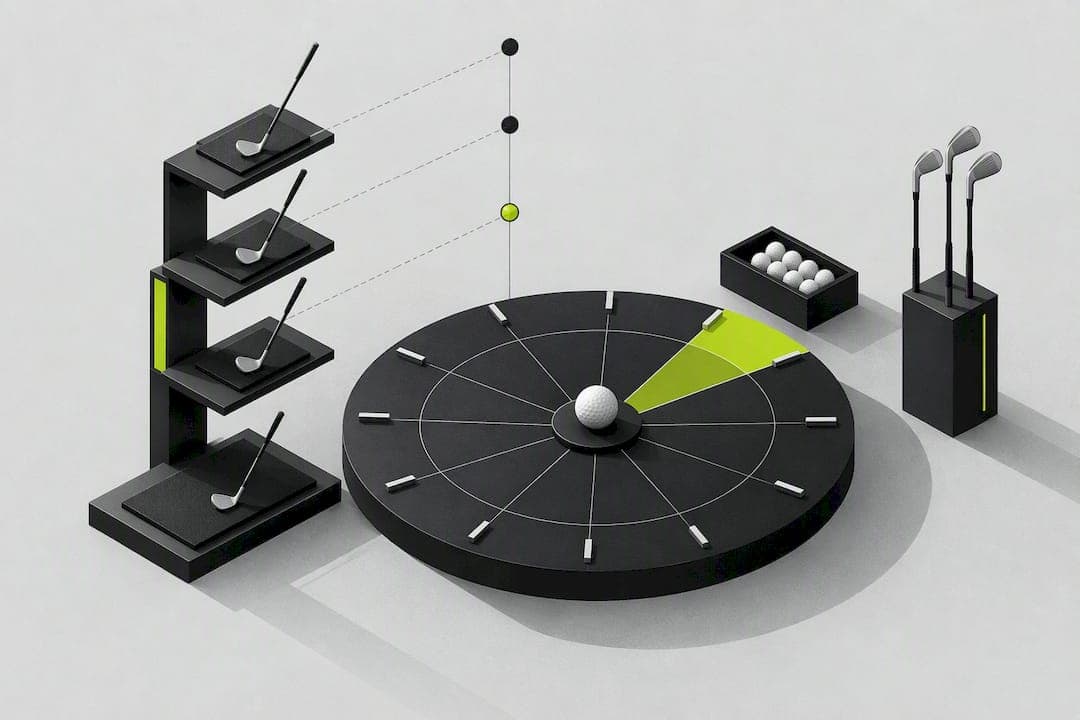
A wedge matrix is a chart of measured carry distances for each wedge at set swing lengths, usually built around clock positions like 7:30, 9:00 and 10:30 plus a full swing. Instead of guessing whether a shot needs a soft sand wedge or a firm gap wedge, you check the number. The payoff is faster, more confident decisions inside 100 to 120 yards, and fewer shots that finish 15 feet short because you guessed instead of measured.
TL;DR:
- Building a wedge matrix typically takes about 30 minutes per wedge, requiring 3 to 5 shots at each key clock position and recording average carry distances.
- Use consistent equipment, a rangefinder or launch monitor, and warm up properly to ensure accurate and reliable measurements of carry distances.
- Regularly re-test and update your matrix after equipment changes, seasonal shifts, or swing adjustments to maintain its accuracy for on-course decisions.
- Applying the matrix involves matching yardage to your target, adjusting for wind, slope, or lie, and shifting clubs or swing lengths rather than guessing.
- Tracking performance over multiple rounds reveals environmental and equipment impacts on carry distances, improving long-term wedge distance control and scoring.
Table of Contents
- How to build a wedge matrix step by step
- Measuring wedge distances accurately and consistently
- Turning your matrix into on-course decisions
- Fixing gaps, overlaps and common wedge questions
- Why tracking your matrix over time beats a one-off test
- Where wedge matrix work fits in a practice plan
- Keep your wedge matrix somewhere you'll actually use it
- Sources
- FAQ
How to build a wedge matrix step by step
Building your own chart is less complicated than it sounds, and most golfers can finish one wedge in under half an hour. The recommended protocol is to hit 3 to 5 balls per position and record the average carry, which takes roughly 30 minutes per wedge. Do all your wedges in one session if you have the time, but don't rush it. Bad data from a rushed session is worse than no data at all.
What you need before you start:
- The wedges you actually play, not borrowed clubs
- Balls you play in competition (a range ball flies differently to your usual model)
- A rangefinder or launch monitor for accurate carry readings
- Flags or targets at known distances, or a wide-open field
- A notebook, spreadsheet, or your phone's notes app
Step-by-step process:
- Warm up properly first. Hit ten or so easy wedge shots before you start recording anything, because cold muscles produce unreliable numbers.
- Pick your first wedge and set up at the 7:30 clock position, meaning the club shaft points to roughly half past seven on an imaginary clock face during your backswing.
- Hit 5 balls from that position, using the same tempo and rhythm each time.
- Record the carry distance for each shot, then calculate the average. Drop the outlier if one shot flies wildly off from the rest.
- Move to 9:00, then 10:30, then a full swing, repeating the same process at each position.
- Repeat the whole sequence for every wedge in your bag.
The wedge clock system works because it converts vague "half swing" or "three-quarter swing" language into a repeatable position you can feel and replicate.
A field-tested shortcut, if walking between targets is eating your practice time: set up four targets on a ladder (perhaps 40, 60, 80 and 100 yards) and test one clock position against each rung before moving to the next position. It cuts down on wasted walking and still gives you a solid average per position.
Once the numbers are in, label the chart in a way you'll actually use on the course. Some players write shaft bands in marker pen showing carry distances by position; others keep a simple photo or note on their phone. A printable card that fits in a yardage book pocket works just as well. The format matters less than whether you'll glance at it standing over a shot.
Pro Tip: Test your matrix on a calm day first. Wind adds a variable you don't need while you're still figuring out your baseline numbers.
Measuring wedge distances accurately and consistently
Carry distance, not total distance, is the number that matters for wedge play. Total distance includes roll, and roll on a wedge shot depends on spin, green firmness and the angle the ball lands at, all of which change from hole to hole. Carry tells you where the ball lands in the air, which is what you're actually trying to control when you're picking a landing spot short of a flag.
If you have access to a launch monitor, log more than just carry. Recording spin rate and launch angle alongside carry distance for each wedge and swing length helps explain why two shots with similar carry numbers behave differently once they land. Titleist's short-game instruction stresses that reliable distance control comes from pairing a repeatable technique with distances charted across several swing lengths, not from chasing a single magic number per club.
No launch monitor? You can still build a usable matrix:
- Use range flags or markers at known distances and watch where the ball first touches down, not where it finishes rolling.
- Pace off distances on a practice fairway if flags aren't available, counting your own stride length as roughly a yard.
- Test on a real green occasionally, since range mats and real turf produce slightly different trajectories and spin.
- Keep the same ball model throughout testing, since a change in ball compression or cover can shift carry by several yards.
- Warm up before every session and average multiple shots rather than trusting a single "good" one.
Why averaging matters: A single great strike can flatter you by 5 to 8 yards, while a single thin shot can undersell your real number by just as much. Averaging 3 to 5 shots per position, as the MyGolfSpy testing protocol recommends, smooths out both extremes and gives you a number you can actually trust under pressure.
Re-test your matrix every few months, and definitely after any equipment change. New wedges, a reground sole, or even a change in grip thickness can shift your numbers by more than most golfers expect. Seasonal changes matter too. Ball flight in cold, dense winter air behaves differently to warm summer conditions, so a matrix built in July may need a light refresh by November.
Turning your matrix into on-course decisions
A wedge matrix is only useful if you can apply it fast, ideally in the 20 or so seconds you have before a shot starts to feel rushed. The workflow is simple once you've drilled it:
- Read the yardage to your landing spot, not the flag, if you're carrying over trouble.
- Check your matrix for the wedge and clock position that matches that carry number.
- Apply a modifier if wind, slope or lie demands one.
- Commit to the shot with the tempo you used on the range.
Wind is the modifier most golfers get wrong. A rough guide many short-game coaches use is one club's worth of adjustment for every 10 miles per hour of wind, though headwinds tend to punish a wedge shot more than a crosswind does because of the added spin and higher trajectory. Downhill lies reduce loft and add distance; uphill lies do the opposite. A ball sitting down in rough kills spin, so expect less stopping power and more roll than your matrix number suggests.
Elevation changes need their own quick rule. Add roughly 1 yard of carry for every yard of drop, and subtract 1 yard for every yard you're hitting uphill, adjusting more aggressively on steep slopes. These aren't exact figures. Course conditions vary too much for that. But they're close enough to keep you in the right window.
One useful habit: rather than changing your swing length mid-round to hit an awkward in-between number, it's usually more reliable to change clubs and use a matrix position you've already drilled. Guessing at a new, untested swing length under pressure is exactly the situation a wedge matrix is meant to eliminate.
Pro Tip: Keep a small notes section next to your matrix for in-round observations, like "downwind 15th hole plays a club shorter." Patterns like this only become obvious once you're tracking them.
Fixing gaps, overlaps and common wedge questions
Loft gaps between wedges are a guideline, not a rule carved in stone. A commonly cited range is 4 to 6 degrees between wedges, but your actual gap should be dictated by what your matrix shows, not by a number in a fitting chart. Golf Digest's instruction on distance control points to four levers you can adjust before buying a new wedge: swing length, club selection, clubface angle and ball position. Test these systematically before assuming your gapping is broken.
Your matrix will usually reveal one of two problems:
- Overlapping distances, where your 9:00 gap wedge and your 7:30 sand wedge carry the same number. Fix this by grip-down for a slightly shorter shaft, or by opening the clubface a touch to add loft without changing swing length.
- Distance gaps, where a 15 to 20 yard hole exists between two wedges. Fix this by finding a usable clock position that fills it, or by reconsidering your wedge lofts entirely.
On common questions: a wedge with 69 degrees of loft is not illegal under the Rules of Golf. The rules govern grooves, material and design characteristics rather than loft itself, so extreme lofts are legal, just impractical for most players. As for whether a 6 degree gap between wedges is too much, it depends entirely on your swing speed and the clock positions you can hit cleanly. For some players it leaves an awkward yardage no-man's-land; for others with a wide range of controlled swing lengths, it's perfectly playable.
Course and turf conditions matter here too. Firm, fast turf reduces the bounce you need, while soft or wet ground calls for more bounce to avoid digging.

Why tracking your matrix over time beats a one-off test
A single testing session gives you a starting point, not the full picture. Logging carry distances round by round exposes patterns a single range session never will, like a systematic tendency to undercarry your 9:00 gap wedge by 4 yards on the course despite hitting the number on the range.
Tools built for round-by-round tracking make this easier than a paper chart ever could. SQR1 Golf offers yardage book exports, course mapping across UK courses, and performance benchmarks that let you store wedge numbers alongside every other statistic from a round, rather than in a separate notebook that gets left in the golf bag.
Patterns that show up once you track consistently:
- Headwinds on specific holes causing repeat undercarry, regardless of club selection
- Seasonal drift as ball compression and course firmness change through the year
- A gap wedge that performs fine on the range but underperforms under on-course pressure
Tracking the same metric across both practice and competitive rounds is what separates a real trend from a single bad day, and it's often the only way to catch a problem that looks like poor technique but is actually an environmental or equipment effect.
Where wedge matrix work fits in a practice plan
Building a wedge matrix is one of the highest-return uses of a practice session, because it directly attacks the guesswork that costs strokes inside 120 yards. That said, a chart of numbers doesn't fix a poor strike, and it won't compensate for weak putting. The best use of limited practice time splits between three things: matrix testing to know your numbers, technique drills to make sure your contact is consistent enough for those numbers to hold up, and putting practice, because a great wedge shot that finishes 8 feet away still needs to go in.
Retest your matrix whenever something changes materially, whether that's new wedges, a reground bounce, or a swing change your coach has been working on with you. Old numbers built on an old swing will mislead you exactly when you need them most.
— Jake
Keep your wedge matrix somewhere you'll actually use it
A notebook works until it's left in the car or the ink runs after a wet round. If you've built a matrix using the range protocol above, the next problem is simple: where does it live, and how easily can you check it mid-round without slowing play? A platform stores your yardage numbers alongside course mapping for many golf courses, so your wedge chart sits in the same place as your hole-by-hole stats rather than a separate sheet you have to dig out.

Because the platform benchmarks every statistic against a player's target handicap rather than a generic average, it is built to show whether wedge numbers are actually helping score, not just whether they look tidy on paper. You can start with the Free plan to see how course mapping and yardage tracking work, or move to the Monthly plan at £4.99 or the Annual plan at £49.99 for the full benchmarking suite. Coaches working with players on wedge gapping can use Coach Pro at £8.99 a month to review the same data directly. Visit the subscribe page to pick the plan that fits how often you play.
Sources
- The sneaky hack to hit every green (MyGolfSpy)
- Dial in your wedge distance technique (Titleist)
- Golf
- How to control distance wedge shots (Golf Digest)
FAQ
How do you make a wedge matrix?
Hit 3 to 5 shots per wedge at each clock position, typically 7:30, 9:00, 10:30 and full swing, and record the average carry distance using a rangefinder or launch monitor. Building one wedge takes about 30 minutes, so a full set can be done across one or two range sessions.
What are the four types of wedges?
The four common types are the pitching wedge, gap wedge, sand wedge and lob wedge, covering a range of lofts. Each fills a different distance and trajectory role, which is exactly why a matrix helps you see where the real gaps sit between them.
Is a 69 degree wedge illegal in golf?
No, loft itself is not restricted under the Rules of Golf, so a 69 degree wedge is legal to carry and play. The rules instead govern groove specifications, materials and design features rather than the degree of loft on the clubface.
Is a 6 degree gap between wedges too much?
It depends on your swing speed and how many clock positions you can hit reliably. A player with a wide, controlled range of partial swings can cover a 6 degree gap comfortably, while a player with only one or two reliable swing lengths per wedge may find it leaves an awkward yardage between clubs.
How much does SQR1 Golf cost?
SQR1 Golf offers a Free plan with no published price, alongside a Monthly plan at £4.99 and an Annual plan at £49.99 for golfers, plus a Coach Pro plan at £8.99 a month for coaches. Full pricing details are available on the subscribe page.